
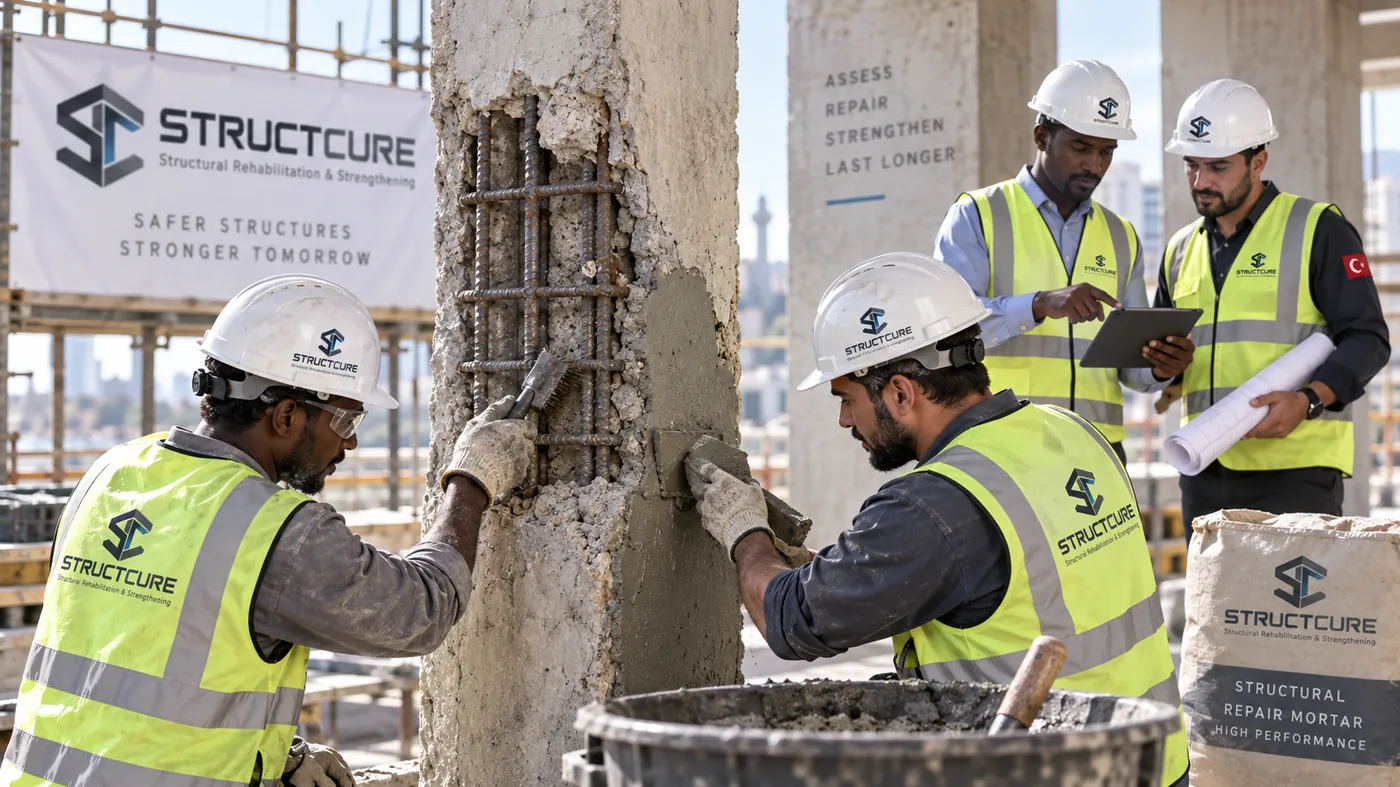
Warning signs
Spalling, delamination, rust staining, exposed reinforcement, widening cracks, leakage, deflection, impact damage and repeated patch failure all justify technical review. A single symptom does not reveal the full cause.
The exact response should be defined from verified site conditions, relevant design information and the performance objective. Where evidence is incomplete, further investigation is safer than assuming the visible symptom tells the whole story.
Assessment comes first
The review should distinguish local defects from systemic deterioration and should consider geometry, loads, reinforcement, exposure, moisture, chlorides, carbonation, previous repairs and access.
The exact response should be defined from verified site conditions, relevant design information and the performance objective. Where evidence is incomplete, further investigation is safer than assuming the visible symptom tells the whole story.
Repair or replace?
Rehabilitation can be appropriate when the remaining structure provides a reliable base and the required performance can be achieved with manageable risk. Replacement may be more rational when deterioration is extensive, access is impractical or the required change is too great.
The exact response should be defined from verified site conditions, relevant design information and the performance objective. Where evidence is incomplete, further investigation is safer than assuming the visible symptom tells the whole story.
Service-life thinking
A durable strategy deals with causes as well as visible damage. Water management, corrosion control, joint performance, cover and protective systems may matter as much as the repair mortar.
The exact response should be defined from verified site conditions, relevant design information and the performance objective. Where evidence is incomplete, further investigation is safer than assuming the visible symptom tells the whole story.
Plan the intervention
Define scope, sequence, temporary support, occupancy constraints, materials, testing, hold points, protection and future inspection before work begins.
The exact response should be defined from verified site conditions, relevant design information and the performance objective. Where evidence is incomplete, further investigation is safer than assuming the visible symptom tells the whole story.
Frequently asked questions
Concrete rehabilitation should be considered when observed deterioration, reduced durability, changing use or verified capacity concerns can be addressed through a controlled intervention that offers a rational service-life benefit.
Yes. General guidance cannot determine the cause, capacity, material compatibility or safe repair scope for a specific structure.