
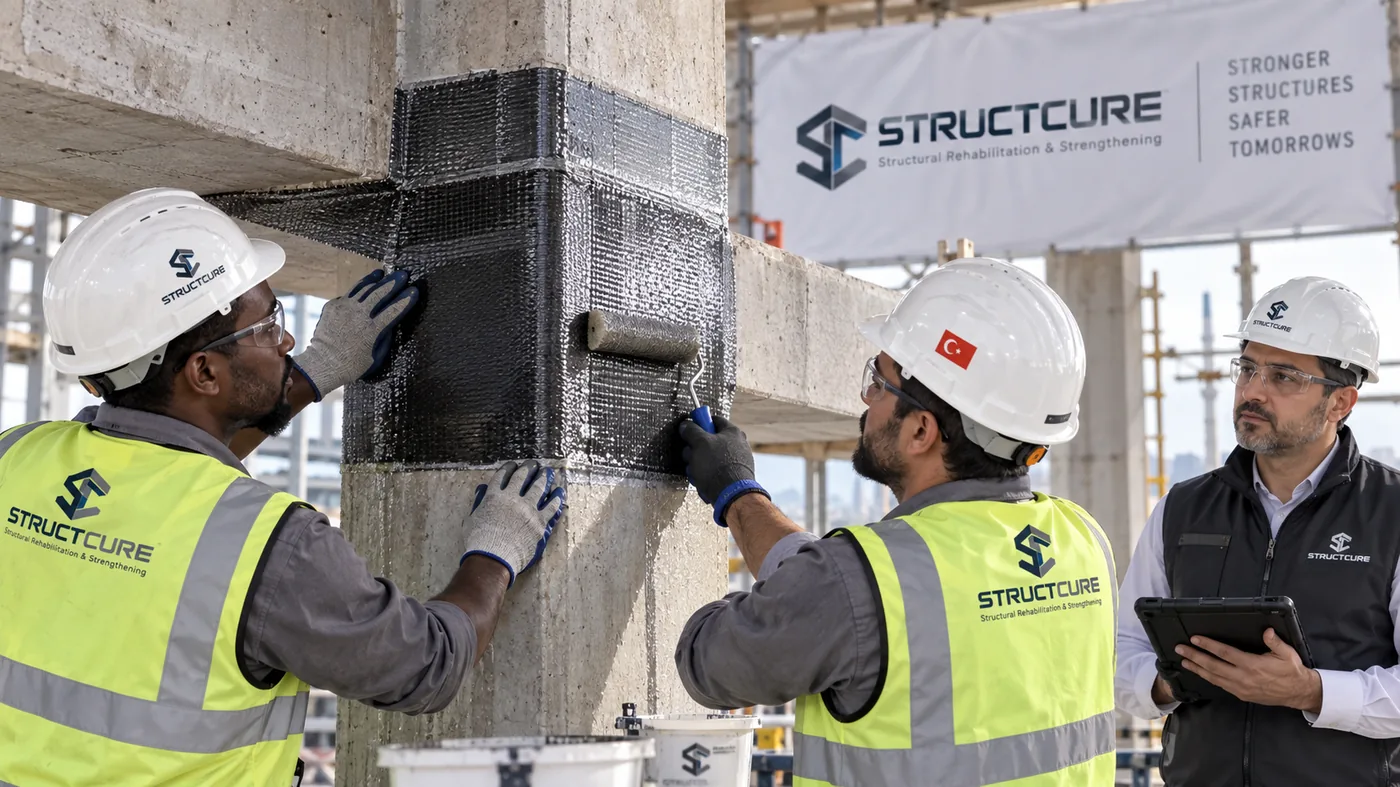
How CFRP works
Carbon fibers carry high tensile forces. In externally bonded systems, those forces must transfer through resin and the prepared substrate into the existing structure. The strength of the fiber alone does not define performance; design, detailing and bond are essential.
The exact response should be defined from verified site conditions, relevant design information and the performance objective. Where evidence is incomplete, further investigation is safer than assuming the visible symptom tells the whole story.
Typical applications
CFRP may strengthen beam or slab flexure, beam shear, column confinement and localized areas around openings. Fabric, sheets, plates or laminates are selected to suit geometry and design intent.
The exact response should be defined from verified site conditions, relevant design information and the performance objective. Where evidence is incomplete, further investigation is safer than assuming the visible symptom tells the whole story.
The execution sequence
Work normally includes verification of the design basis, repair of deteriorated concrete, profiling and cleaning, substrate acceptance, priming and leveling, controlled resin application, fiber placement, consolidation, cure and inspection.
The exact response should be defined from verified site conditions, relevant design information and the performance objective. Where evidence is incomplete, further investigation is safer than assuming the visible symptom tells the whole story.
Key limitations
Fire and elevated temperature, moisture, exposure, impact, anchorage, debonding, substrate tensile strength and access must be considered. CFRP should not conceal unresolved corrosion, weak concrete or active movement.
The exact response should be defined from verified site conditions, relevant design information and the performance objective. Where evidence is incomplete, further investigation is safer than assuming the visible symptom tells the whole story.
Quality controls
Typical controls include surface profile, substrate moisture and temperature, resin batch and mixing records, fiber orientation, lap and termination details, entrapped-air inspection, cure protection and pull-off testing where specified.
The exact response should be defined from verified site conditions, relevant design information and the performance objective. Where evidence is incomplete, further investigation is safer than assuming the visible symptom tells the whole story.
Frequently asked questions
CFRP strengthening uses carbon-fiber reinforcement bonded to prepared structural elements to add selected tensile, shear or confinement capacity with minimal added weight and thickness.
Yes. General guidance cannot determine the cause, capacity, material compatibility or safe repair scope for a specific structure.