The practical difference
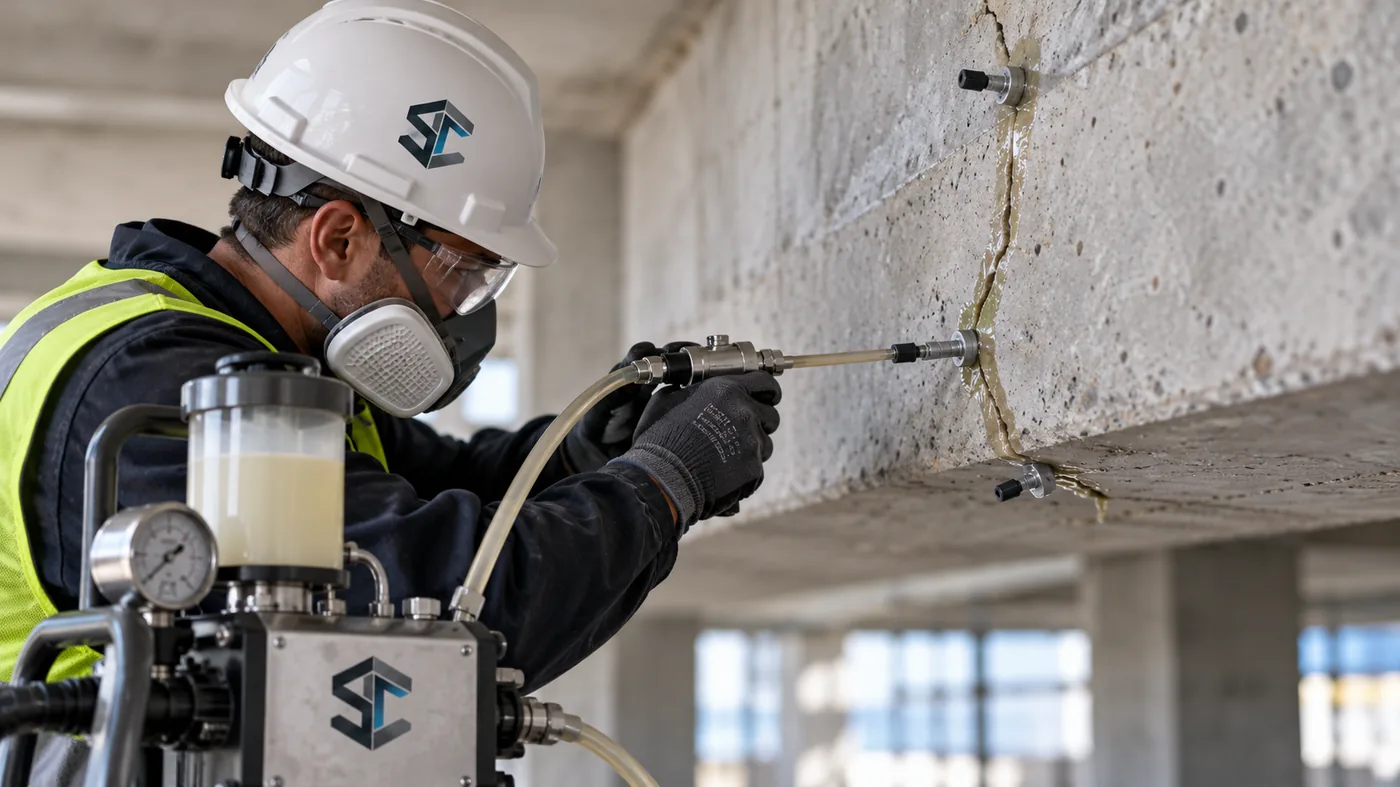
Epoxy resins cure into a rigid bonded material and may restore continuity across suitable cracks. Polyurethane resins can react with water, expand or remain flexible depending on formulation, making them useful for sealing active water paths.
The exact response should be defined from verified site conditions, relevant design information and the performance objective. Where evidence is incomplete, further investigation is safer than assuming the visible symptom tells the whole story.
Choose by objective, not appearance
A crack should first be classified by cause, movement, moisture and structural significance. A dry stable crack with a structural repair objective may suit epoxy. An actively leaking path may require PU, drainage or joint treatment.
The exact response should be defined from verified site conditions, relevant design information and the performance objective. Where evidence is incomplete, further investigation is safer than assuming the visible symptom tells the whole story.
Comparison
| Question | Epoxy | Polyurethane |
|---|---|---|
| Primary objective | Structural bonding | Water control / sealing |
| Typical movement tolerance | Low; crack should be stable | Formulation-dependent flexibility |
| Water during injection | Usually dry or controlled | Often selected for wet conditions |
| Restores structural continuity | Potentially, when designed and executed correctly | Generally not the purpose |
What must be checked
Confirm crack activity, access, width and continuity; locate water sources; review load path and structural relevance; check substrate and contamination; then define ports, pressure, sequence and acceptance criteria.
The exact response should be defined from verified site conditions, relevant design information and the performance objective. Where evidence is incomplete, further investigation is safer than assuming the visible symptom tells the whole story.
Common mistake
Injecting a product before understanding the crack can hide evidence without correcting the cause. Movement joints, thermal cracks, settlement, corrosion-related cracking and overloaded members need different responses.
The exact response should be defined from verified site conditions, relevant design information and the performance objective. Where evidence is incomplete, further investigation is safer than assuming the visible symptom tells the whole story.
Frequently asked questions
Epoxy injection is primarily a structural bonding method for suitable stable cracks; polyurethane injection is primarily a water-control method for leakage paths. They solve different problems and are not interchangeable.
Yes. General guidance cannot determine the cause, capacity, material compatibility or safe repair scope for a specific structure.